


3D Printing Fundamentals: Modelling and Prototyping
Course information
Course objective: to provide the core theoretical knowledge and practical skills required to independently create 3D models, prepare them for printing, set up the equipment and carry out the full 3D printing cycle.
The course is held in classroom format in a modern computer lab at Tartu mnt. 18, Tallinn. Group size: 6 to 10 students. All learning materials are included in the course price. A laptop can be provided during the course if needed.
Various funding options are available for this course, including government support schemes and non-profit organisation programmes. Get in touch with our consultant for more detailed information.
Target group:
This course is for you if you:
- are a complete beginner and want to learn 3D modelling and printing from scratch;
- are a designer or constructor and would like to create and print your own 3D models and prototypes;
- are an engineer or technologist and need to use prototyping in product development;
- are a maker, inventor or DIY enthusiast and are interested in turning ideas into physical objects;
- are an entrepreneur or small business owner and plan to launch printing and prototyping services or small-batch production;
- are changing careers from another field and want to enter additive technologies and digital manufacturing;
- are a student of a technical or design discipline and would like practical skills and a portfolio of finished items;
- are a teacher or lab/club supervisor and need to bring 3D printing into teaching and projects.
Requirements for students:
- secondary education
- confident PC user
- English proficiency sufficient for reading technical documentation (approximately A2/B1 level)
- own laptop recommended (Windows / Mac, RAM 8 GB, screen size > 13.3 inches); a laptop can be provided during the course if needed.
Learning outcomes:
Those who complete this course:
- understand the principles, technologies and capabilities of 3D printing
- can create and prepare 3D models for printing
- know the properties and applications of different 3D printing materials
- have the skills to set up, maintain and calibrate 3D printers
- apply quality control and post-processing methods for printed items
- develop and implement their own 3D printing projects
Teaching methods:
Total course volume: 180 academic hours, of which 100 academic hours are delivered in the classroom (including 8 ac. h. of practical sessions and 2 seminars (8 ac. h.))
Assessment criteria:
Learning outcomes are assessed based on independently completed practical assignments.
Assessment methods:
Upon successful completion, practical and homework assignments receive a "pass" grade.
Graduation requirements:
To successfully complete the course and receive a certificate, students must pass 75% of all homework assignments.
Additional information:
Basic rules for organising training (in Estonian)
Basic rules for ensuring the quality of the educational process (in Estonian)
Course curriculum
| Module | Main module topics | Duration |
| 1. Introduction to 3D printing |
|
10 hours |
| 2. Working with 3D models |
|
20 hours |
| 3. Materials for 3D printing |
|
15 hours |
| 4. Printer setup and maintenance |
|
10 hours |
| 5. Preparing for printing |
|
15 hours |
| 6. Post-processing |
|
10 hours |
| 7. Applications of 3D printing in various fields |
|
10 hours |
| 8. Project work |
|
10 hours |
Course details
Time of conduct:
For exact course date information, please submit an application.
Timetable:
Mon, Wed, Fri 17:45 - 21:00
Apply →We'll reply within 1 business day
Course length:
9 weeks
Format and location:
Address: Tartu mnt. 18, Tallinn.
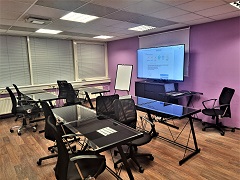
The course is held in classroom format in a modern computer lab. Group size: 6 to 10 students
Language of instruction: English
Price: 2440 EUR (VAT 24% included)
Total course volume: 180 ac. h.
Includes:
- Classroom sessions: 100 ac. h. (including 4 ac. h. of practical sessions and 2 seminars (4 ac. h.))
- Independent study: 80 ac. h.
Instructors
Daniil Zemtsovski
Qualification: Entrepreneur and business founder with over 7 years in in-house manufacturing and 3D printing.Specialisation: 3D printing and additive manufacturing, 3D modeling, prototyping and made-to-order fabrication
Teaching experience: instructor at Gamma Intelligence for 3D modeling and CNC
Education: Euroakadeemia — Bachelor of Business Administration (2017); Informatika ja arvestustehnika kool — vocational secondary, database management (2014).