


This 2-month evening course in the centre of Tallinn walks you through the whole CNC chain — CAD design, CAM toolpaths and machining on real equipment, with 42 academic hours of hands-on workshop practice.
End-to-End CNC Engineering Course: CAD, CAM, and Machining Workflow
19.10.2026 - 23.12.2026
Target group — this course is for you if you are:
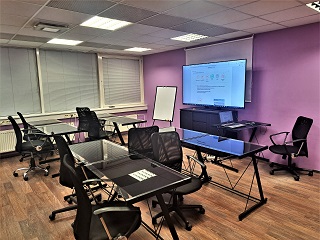 Our classroom at Tartu mnt. 18, Tallinn
 A laptop is provided for the training period if needed
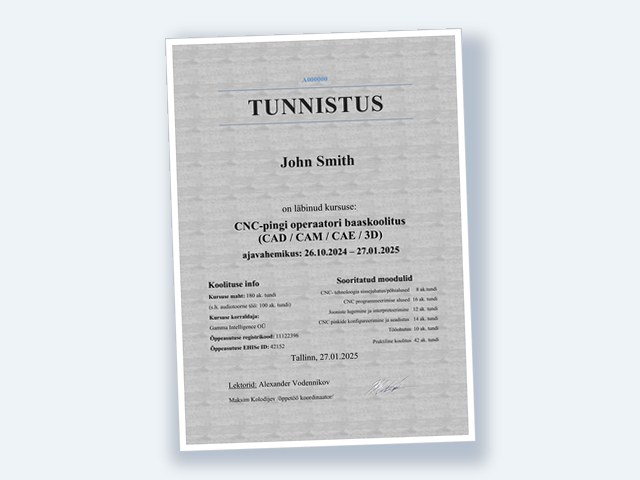 Official certificate of completion (issued in Estonian)
 We advise on the job market
Course objective
To provide basic theoretical knowledge and fundamental practical skills required to work as a CNC machine operator.
Learning outcome — those who complete this course:
Technologies you will learn during the course:
 Design parts in Autodesk Fusion 360 (CAD)
 Generate toolpaths in CAM (Vectric Aspire)
 Run CNC machines with G-code / M-code
Course modules:
| Module | Main topics | Volume |
| 1. Introduction to CNC machines and their basic principles of operation |
|
8 ac/h |
| 2. Basics of programming CNC machines. |
|
16 ac/h |
| 3. Reading and interpreting blueprints. |
|
12 ac/h |
| 4. Setting up and preparing the CNC machine for operation. |
|
14 ac/h |
| 5. Safety and operation of CNC machines. |
|
10 ac/h |
| 6. Practical training and exercises. |
|
42 ac/h |
- confident PC user
- basic proficiency in English (approximately corresponding to A1/A2 level)
The total course volume is 180 academic hours, of which 100 academic hours are conducted in the classroom (including 42 academic hours of practical sessions and 2 seminars totalling 8 academic hours).
Learning outcomes are assessed based on independently completed practical work.
Upon successful completion, practical and homework assignments receive a "pass" grade.
To successfully complete the course and receive a certificate, it is necessary to achieve a "pass" grade on 75% of the homework assignments.
Ready to start? The next groups begin:
19.10.2026 - 23.12.2026
Contact us for a free consultation.
Apply → We'll reply within 1 business dayTotal course volume: 180 ac/h
Includes classroom sessions 100 ac/h (of which 42 ac/h practical sessions and 2 seminars, 8 ac/h in total) and independent study 80 ac/h. Training is conducted in a workshop classroom at Tartu mnt. 18, Tallinn; the group size is up to 6 people.
Tutors
Daniil Zemtsovski
Qualification: Entrepreneur and business founder with over 7 years in in-house manufacturing and 3D printing.Specialisation: 3D printing and additive manufacturing, 3D modeling, prototyping and made-to-order fabrication
Teaching experience: instructor at Gamma Intelligence for 3D modeling and CNC
Education: Euroakadeemia — Bachelor of Business Administration (2017); Informatika ja arvestustehnika kool — vocational secondary, database management (2014).