


Linux for Beginners
Course information
Course objective: to provide basic theoretical knowledge and practical skills for working with the Linux operating system, required by IT specialists for administration, support, testing, and software development. Training is conducted in a classroom format in the centre of Tallinn (Tartu mnt. 18, Tallinn) and/or online via Zoom. Group size is up to 8 participants. All training materials are included in the course price. A laptop can be provided for the duration of the course if needed.
Various funding options are available for this course, including government support schemes and non-profit organisation programmes. Get in touch with our consultant for more detailed information.
Target audience:
This course is for you if you:
- are a system administrator and want to administer Linux servers and services confidently;
- are a developer and would like to understand the working environment, builds and deployment on Linux;
- are a QA engineer or tester and need to spin up and maintain test environments on Linux;
- are a technical support specialist and are interested in the command line, diagnostics and log analysis;
- are a future DevOps or cloud specialist and plan to build a solid Linux foundation;
- are a network engineer and need to use Linux tools for networking tasks;
- are a newcomer to IT or career changer and want to master an operating system central to the industry;
- are a student of a technical discipline and would like hands-on Linux skills.
What you'll learn on this course:
 Master the Linux command line
 Write Bash scripts to automate tasks
 Manage services with systemd
 Connect to servers securely with SSH
 Run network diagnostics over TCP/IP
Requirements:
Learning outcomes:
Those who complete this course:
- understand Linux architecture and operating system principles
- confidently work in the command line and use core utilities
- work with the file system: permissions, links, search and archiving
- manage processes and system resources (CPU/RAM/Disk) and perform basic troubleshooting
- manage services using systemd and analyse logs (journalctl, /var/log)
- manage users and permissions (users/groups/sudo) and apply basic security practices
- use SSH for remote access and understand key-based authentication and basic hardening
- understand networking fundamentals (TCP/IP, DNS, HTTP/HTTPS) and diagnose network issues
- use firewall tools at a basic level (UFW/iptables — overview) and verify service availability
- write simple Bash scripts and automate tasks (cron/systemd timers)
Training methods:
Total course volume: 42 academic hours, of which 28 academic hours are conducted in a classroom and/or live online sessions with an instructor.
Assessment criteria:
Learning outcomes are assessed based on completed practical assignments and a final lab work.
Assessment methods:
Upon successful completion, practical and homework assignments receive a "pass" grade.
Course completion conditions:
To successfully complete the course and receive a certificate, participants must pass key practical assignments and the final lab work.
Additional information:
General rules of study organisation (in Estonian)Quality assurance rules of the training process (in Estonian)
Course Program
| Module | Main topics | Hours |
| 1. Linux for IT: CLI basics and file system |
|
6 hrs |
| 2. Processes, resources, services and logs |
|
6 hrs |
| 3. Users, permissions and basic security |
|
5 hrs |
| 4. Networking in Linux and diagnostics |
|
6 hrs |
| 5. Bash and task automation |
|
5 hrs |
| TOTAL | 28 hrs |
Course information
Schedule:28.09.2026 - 23.10.2026
09.11.2026 - 27.11.2026
Class time:
Mon, Wed 18:00–21:00
Apply →We'll reply within 1 business day
Course length: 3–5 weeks (depending on schedule)
Format and location:
Address: Tartu mnt. 18, Tallinn / Online.
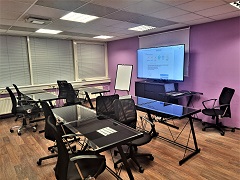
Classroom-based training (and/or online via Zoom). Group size up to 8 participants.
Language of instruction: English
Price: 784 EUR + VAT 24%
Total course volume: 42 academic hours, of which 28 academic hours are conducted in classroom and/or live online sessions with an instructor.
Instructors
Nikolai Zubrilov
Qualification: practicing engineer in operations and automation.Specialisation: Linux, administration, automation, troubleshooting.
Teaching experience: 5 years of teaching and consulting.
Education: Master’s degree in computer and systems engineering