


Comprehensive Software Testing Course: QA and Test Automation in Python with Robot Framework
Course Information
Course objective: to provide the basic theoretical knowledge and practical skills needed to start working in the field of software testing.
The training takes place in the centre of Tallinn, at Tartu mnt. 18. All study materials are included in the course price. A laptop can be provided for the duration of the course if needed.
Various funding options are available for this course, including government support schemes and non-profit organisation programmes. Get in touch with our consultant for more detailed information.
Target group:
This course is for you if you:
- are a newcomer with no IT experience and want to enter the testing profession from scratch;
- are a specialist from another field and are choosing QA as one of the most accessible entry points into the industry;
- are a manual tester and would like to master automation and grow into an AQA engineer;
- are a junior developer and are interested in testing processes and writing automated tests;
- are a business analyst or product manager and need an understanding of QA processes, requirements and acceptance criteria;
- are a technical-support specialist and want to move into an engineering QA role;
- are a freelancer or project owner and need to test your own products yourself, including with automation;
- are a student of a technical discipline or a graduate and would like to gain practical skills and a portfolio.
What you'll learn on this course:
 Manage tasks and bugs in Jira
 Keep project documentation in Confluence
 Get to know Xray for test cases in Jira
 Master version control with Git for teamwork
 Learn SQL to validate data in databases
 Practise API testing in Postman
 Understand REST API testing
 Use Chrome DevTools to debug in the browser
 Pick up Python for test automation
 Automate web tests with Selenium
 Build automated tests on Robot Framework
 Write code in the VS Code editor
Requirements for students:
- Confident PC user
- English at a level sufficient for reading technical documentation (approximately A2/B1)
- Preferably with your own laptop (Windows / Mac, 8 GB RAM, screen size > 13.3"); a laptop can be provided for the duration of the course if needed.
Learning Outcomes:
Those who complete this course:
- Understand the software development process and the role of testing within it;
- Understand how high-quality software is created;
- Be able to use various methods to check software quality;
- Be able to find bugs in software;
- Be able to plan the testing process;
- Understand the role of automated testing and automate scenarios using Python / Robot Framework.
Learning Methods:
Total course volume: 220 academic hours, of which:
- 120 academic hours take place in the classroom (including 8 hours of practical work and 2 seminars totalling 8 academic hours) or online (Zoom)
- 100 academic hours take place outside the classroom as independent work
Assessment Criteria:
Learning outcomes are assessed on the basis of independently completed practical work.
Assessment Methods:
Upon successful completion, practical and homework assignments receive a "pass" grade.
Course completion conditions:
To successfully complete the course and receive a certificate, at least 75% of the homework assignments must be passed.
Additional Information:
Curriculum group: 0613 - Software and applications development and analysis (0613 - Tarkvara ja rakenduste arendus ning analüüs õppekavarühm)
General rules for organising studies (in Estonian)
Rules for ensuring study quality (in Estonian)
Course program
| Module | Main topics | Duration |
| Modern software development (Introduction to Software Development) |
|
4 acad. hrs |
| The concept of software quality (Software Quality) | 16 acad. hrs | |
| Software quality control (Software Quality Control) | 20 acad. hrs (incl. 4 h seminar + 4 h practice) | |
| Software quality assurance methods (Software Quality Assurance) |
|
20 acad. hrs (incl. 4 h seminar + 4 h practice) |
| Test automation. Block 1: Python fundamentals | |
24 acad. hrs |
| Test automation. Block 2: Robot Framework | |
36 acad. hrs |
Course Details
Course Schedule:
02.11.2026 - 02.02.2027
Class Time:
Mon, Wed, Thu 14:30 - 17:45
Mon, Wed, Thu 18:00 - 21:15
Apply →We'll reply within 1 business day
Course length:
13 weeks
Format and Location:
Address: Tartu mnt. 18, Tallinn.
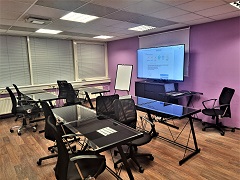
The course is held in a classroom format, in a modern computer lab, or online (Zoom). Group size from 6 to 10 people.
Language of Instruction: English
Price: 2456 EUR (VAT 24% included)
Total Course Volume: 220 acad. hrs
Includes:
- Classroom sessions: 120 acad. hrs (including 8 practical hrs and 2 seminars – 8 acad. hrs)
- Independent work (outside the classroom): 100 acad. hrs
Instructors
Maksim Kolodijev
 Qualification: Over 15 years in software development. Over 8 years of experience in software testing.
Specialisation: Software development process, software testing, test automation, data analysis
Teaching Experience: Over 5 years of teaching and consulting experience
Education: TalTech, Master's degree (2007)
Roman Kutselepa
 Qualification: Over 5 years in software development.
Specialisation: web design, JavaScript development, effective use of software products in a company
Teaching Experience: Over 5 years of experience in teaching and staff training
Education: Anglia Ruskin University, 2010 (England)