


Intensive software testing course for beginners
Information about training in this course
Course objective: to provide basic theoretical knowledge and fundamental practical skills necessary to start working in the field of software testing.
Training takes place in the centre of Tallinn at Tartu mnt. 18. All educational materials are included in the course price. A laptop is provided for the duration of the training if needed.
Various funding options are available for this course, including government support schemes and non-profit organisation programmes. Get in touch with our consultant for more detailed information.
Target group:
This course is for you if you:
- are a beginner with no IT experience and want to enter the QA profession from scratch;
- are changing careers from another field and are looking at QA as one of the most accessible entry points into the industry;
- are a manual tester and would like to systematise your knowledge and prepare to move into automation;
- are an aspiring developer and are interested in testing processes, to write higher-quality code;
- are a business analyst or product manager and need to understand QA processes, requirements and acceptance criteria;
- are a technical support specialist and plan to move into an engineering QA role;
- are a freelancer or project owner and want to master testing tools (Jira, Git, Postman, SQL, Selenium) for your products;
- are a student or graduate of a technical discipline and would like practical skills and a portfolio.
What you'll learn on this course:
 Manage tasks and bugs in Jira
 Document projects in Confluence
 Get to know test management with Xray
 Master version control with Git
 Automate web tests with Selenium
 Learn SQL to verify data
 Test APIs with Postman
 Explore mobile testing in Android Studio
 Debug in the browser with Chrome DevTools
Requirements for students:
Learning outcome:
Those who complete this course:
- understand the software development process and the role of testing within it;
- understand how high-quality software is created;
- are able to use various methods for quality assurance in software;
- are able to identify defects in software;
- are able to plan the testing process;
- understand the role of automated testing and automate simple scenarios using Selenium IDE;
Training methods:
The total course volume: 120 academic hours, of which
- 80 academic hours are conducted in the classroom (including 8 academic hours of practical sessions and 2 seminars totalling 8 academic hours)
- 40 academic hours are conducted outside the classroom as independent work
Evaluation criteria for learning outcomes:
Learning outcomes are assessed based on independently completed practical work.
Evaluation methods:
Upon successful completion, practical and homework assignments receive a "pass" grade.
Course completion conditions:
To successfully complete the course and receive a certificate, it is necessary to achieve a "pass" grade on 75% of the homework assignments.
Additional information:
Training programme group: 0688 - Information and communication technologies interdisciplinary study group (0688 Informatsiooni- ja kommunikatsioonitehnoloogia interdistsiplinaarne õppekavarühm)Basic rules for training organisation (in Estonian)
Basic rules for ensuring the quality of the educational process (in Estonian)
| Module | Main topics | Volume |
| Introduction to Software Development |
|
4 ac/h |
| The concept of software quality | 16 ac/h | |
| Software Quality Control | Seminar: Overview of the job market and vacancies related to software testing. |
20 ac/h (includes a 4 ac/h seminar and 4 ac/h of practical work in the classroom) |
| Methods of ensuring software quality |
Seminar: Solving test assignments related to software testing. |
20 ac/h (includes a 4 ac/h seminar and 4 ac/h of practical work in the classroom) |
| Introduction to test automation (Software Testing Automation) | Using automated tests. Practical work | 20 ac/h |
Course information
Time of conduct:28.09.2026 - 27.11.2026
Timetable:
Mon, Wed, Thu 14:30 - 17:45
Mon, Wed, Thu 18:00 - 21:15
Apply →We'll reply within 1 business day
Course length: 8 weeks
Format and place of conduct:
Address: Tartu mnt. 18, Tallinn.
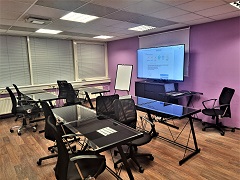
The course is conducted in a classroom format, in a modern computer class. The group size ranges from 6 to 10 people.
Training language: English
Price: 1935.48 EUR + VAT 24%
Total course volume: 120 ac/h
Includes:
- Classroom sessions: 80 ac/h including 8 ac/h of practical sessions and 2 seminars (8 ac/h).
- Independent study: 40 ac/h
Tutors
Maksim Kolodijev
 Qualification: Over 15 years in software development; over 8 years of experience in software testing. Specialisation: Software development process, software testing, test automation, data analysis.
Teaching experience: Over 5 years of experience in teaching and consulting.
Education: TalTech, Master's degree (2007)
Roman Kutselepa (assistant)
 Qualification: over 5 years of Python development and over 3 years of JavaScript development; participated in software-integration projects.
Specialisation: Python development, web development, software solution integration.
Teaching experience: over 5 years of teaching and staff-training experience.
Education: Anglia Ruskin University, higher education (2010)