


Fundamentals of the Python Programming Language
Information about training in this course
Course objective: to teach the Python language and its practical use in everyday programming tasks.
Target audience: The course is intended for those who wish to gain theoretical and practical skills in applied programming and developing applications in the Python programming language, and who are considering a career in the IT field.
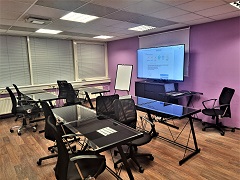
Training takes place in a classroom format, in a modern computer lab at Tartu mnt. 18, Tallinn. Group size from 6 to 10 people. The course price includes all study materials. If necessary, a laptop is provided for the duration of the training.
Requirements for students:
Learning outcomes:
Upon completion of this course, students will be able to:
Teaching methods:
Total course volume: 64 academic hours, of which 36 academic hours are in-class (including 4 academic hours of practical sessions and 2 seminars (4 academic hours)).
Assessment criteria for learning outcomes:
Learning outcomes are assessed based on independently completed practical assignments.
Assessment methods:
If completed successfully, practical and homework assignments receive a "pass" grade.
Course completion conditions:
To successfully complete the course and receive a certificate, you must pass 75% of the homework assignments.
Additional information:
Education programme group: 0613 - Software and Applications Development and Analysis (0613 - Tarkvara ja rakenduste arendus ning analüüs)General rules of study organisation (in Estonian)
General rules for ensuring the quality of the study process (in Estonian)
Course programme
| Session | Main topics of the session | Volume |
|---|---|---|
| 1. Introduction to Python | What Python is and where it’s used. Installing Python and setting up the environment. Getting to know IDLE and Jupyter Notebook. Variables and data types (int, float, str, bool). Operators and basic calculations. Practice: Creating simple programs and interactive work | 4 acad. hrs |
| 2. Conditions and decision-making | Conditional statements if, elif, else. Comparison and logical operators. Nested conditions. Ternary operator. Practice: Programs with branching logic, data validation | 4 acad. hrs |
| 3. Loops and automation | The for loop for iteration. The while loop for repeated operations. The range() function and its parameters. Loop control: break, continue, else. Practice: Automating repetitive tasks | 4 acad. hrs |
| 4. Working with lists | Creating lists and accessing elements. Indexing, slices and their use. List methods: append(), remove(), insert(), pop(), sort(). Nested lists and multidimensional structures. List comprehensions. Practice: Processing data collections | 4 acad. hrs |
| 5. String and text processing | Strings as sequences of characters. String methods: split(), join(), replace(), strip(), find(). String formatting: f-strings, format(), % formatting. Working with multi-line text. Practice: Processing and analysing textual information | 4 acad. hrs |
| 6. Dictionaries and structured data | Creating dictionaries and working with key–value pairs. Dictionary methods: keys(), values(), items(), get(). Iterating over dictionaries. Sets and their operations. Combining data structures. Practice: Organising and searching for information | 4 acad. hrs |
| 7. Functions and code modularity | Defining functions with def. Parameters, arguments and return values. Variable scope. Higher-order functions. Lambda functions. Practice: Creating reusable code | 4 acad. hrs |
| 8. Files, modules and error handling | Reading and writing files. Working with CSV and text formats. Importing modules and the standard library. Installing external packages with pip. Exception handling: try, except, finally. Practice: Working with external data and libraries | 4 acad. hrs |
| 9. Object-oriented programming | Basics of OOP: classes and objects. Attributes and methods. The __init__ constructor. Encapsulation and basic inheritance. Final project: Creating an application using all studied concepts | 4 acad. hrs |
Course information
Time of delivery:21.09.2026 - 22.10.2026
19.10.2026 - 16.11.2026
Class schedule:
Tue, Thu, Fri 17:45 - 21:00
Apply →We'll reply within 1 business day
Course length: 4 weeks
Format and venue:
Address: Tartu mnt. 18, Tallinn.
The course is conducted:
- in a classroom format, in a modern computer lab, at Tartu mnt. 18.
- in a remote format (Zoom or Microsoft Teams).
Language of instruction: English
Price: 1339.2 EUR (VAT 24% included)
Total course load: 64 acad. hrs
Includes:
- In-class sessions: 36 acad. hrs (incl. practical sessions 4 acad. hrs and 2 seminars (4 acad. hrs)
- Independent work: 28 acad. hrs
Instructors
Roman Kutselepa
 Qualifications:
Over 5 years in software development. Specialisation: web design, JavaScript development, effective use of software products in a company
Teaching experience: Over 5 years of experience in teaching and staff training
Education: Anglia Ruskin University, 2010 (UK)