
Production-first backend Python Developer — backend in Python from scratch, with AI integration
Information about training in this course.
Course objective:
to provide, from scratch, the theoretical knowledge and practical skills required to work as a Python backend developer:
from the fundamentals of the language to designing, testing and deploying a real backend service — API, database,
asynchronicity, background tasks and AI integration.
Training takes place in the centre of Tallinn (Tartu mnt. 18, Tallinn) and/or online.
The group size is up to 10 people. All educational materials are included in the course price.
A laptop is provided for the duration of the training if needed.
No prior programming experience is required — the course is designed for beginners.
Target group:
This course is for you if you:
- are a beginner and want to learn backend development in Python from scratch, with no prior experience;
- are changing careers and want to enter IT through the in-demand field of backend development;
- are a student or graduate of a technical discipline and need practical skills and a project for your portfolio;
- are a markup or frontend specialist and are interested in moving to the server side;
- have studied Python on your own and want to systematise your knowledge to a junior backend developer level;
- are a specialist in an adjacent IT role (support, QA, analytics) and plan to move into development.
Requirements for students:
- confident PC user
- basic English (approximately A2/B1) for reading documentation
- no prior programming experience is required
- It is desirable to have your own laptop (Windows / Mac / Linux, 8 GB RAM+); a laptop will be provided for the duration of the training if needed.
Learning outcome:
Those who complete this course:
- write programs in Python (OOP, typing, clean code)
- work with PostgreSQL and SQL, design and normalise data schemas
- build REST APIs with FastAPI, including validation (Pydantic) and authentication (JWT)
- apply asynchronicity (asyncio) and background tasks (Celery, Redis)
- containerise and deploy a service (Docker, CI/CD, GitHub Actions)
- integrate LLM/AI (LangChain) and real-time (SSE / WebSockets) into the backend
Training methods:
The total course volume is 145 academic hours. Format: lectures + practical work + independent work. The course is built in layers — from language fundamentals to design, infrastructure and AI integration.
Evaluation criteria for learning outcomes:
Learning outcomes are assessed based on independently completed practical work and a final mini-project (a backend service).
Evaluation methods:
Upon successful completion, practical and homework assignments receive a "pass" grade.
Course completion conditions:
To successfully complete the course and receive a certificate, it is necessary to achieve a "pass" grade on the key practical assignments and the final mini-project.
Additional information:
Training programme group: 0613 - Software and applications development and analysis (0613 - Tarkvara ja rakenduste arendus ning analüüs)
Basic rules for training organisation (in Estonian)
Basic rules for ensuring the quality of the educational process (in Estonian)
Course program
| Module | Main topics | Volume |
| 0. Introductory lesson |
|
2 ac/h |
| 1. Python Core Fundamentals |
|
20 ac/h |
| 2. Functions & Clean Code |
|
10 ac/h |
| 3. OOP & Advanced Python |
|
14 ac/h |
| 4. Databases & SQL |
|
16 ac/h |
| 5. Web Fundamentals |
|
4 ac/h |
| 6. FastAPI & Modern Backend Development |
|
28 ac/h |
| 7. Async Python & Concurrency |
|
10 ac/h |
| 8. AI Backend & LangChain |
|
8 ac/h |
| 9. Real-time APIs (WS / SSE) |
|
6 ac/h |
| 10. Testing & Code Quality |
|
10 ac/h |
| 11. Background Tasks & Scalable Backend |
|
7 ac/h |
| 12. Docker, CI/CD & Deployment |
|
10 ac/h |
| TOTAL | 145 ac/h |
Course information
Time of conduct:
17.08.2026 - 17.12.2026
Timetable:
Evening groups: 2–3 times a week, 18:00–21:00.
Apply → We'll reply within 1 business day
Course length:
4 months (17.08.2026 – 17.12.2026)
Format and place of conduct:
Address: Tartu mnt. 18, Tallinn / Online.
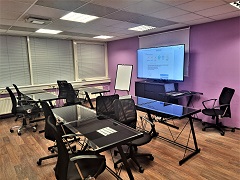
The course is conducted in a classroom format (and/or online). The group size is up to 10 people.
Training language: English
Price: 1950 EUR + VAT 24%
Total course volume: 145 ac/h
Format: lectures + practical work + independent work.
Tutors
Nikolay Zubrilov
Qualification: Python developer and Data Scientist; commercial experience in backend development, data analysis and AI/LLM.Specialisation: Python, FastAPI / Flask, SQL (PostgreSQL / MySQL), asynchronicity, LLM integration.
Teaching experience: instructor on Python and data analysis courses.
Education: Baltic Fishing Fleet State Academy, Bachelor of Engineering (2019).
Roman Kutselepa
 Qualification: over 5 years of Python development and over 3 years of JavaScript development; participated in software-integration projects.
Specialisation: Python development, web development, software solution integration.
Teaching experience: over 5 years of teaching and staff-training experience.
Education: Anglia Ruskin University, higher education (2010).