


This 3-week intensive in the centre of Tallinn gives you SQL as a working analysis tool — from your first queries to JOINs, window functions and time-series analysis, so you can get the data you need without waiting for a developer.
Data Analysis with SQL
16.11.2026 - 04.12.2026
Target group — this course is for you if you are:
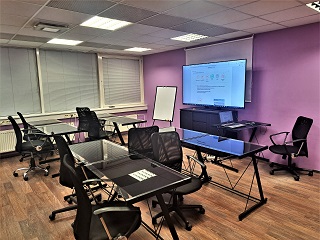 Our classroom at Tartu mnt. 18, Tallinn
 A laptop can be provided for the duration of the course if needed
 We advise on the job market
Course objective
To learn the fundamentals of working with relational databases and the structured query language SQL, and to use SQL for the initial analysis of data.
Learning outcome — those who complete this course:
Technologies you will learn during the course:
 Write queries in SQL
 Work with the MySQL database
 Understand relational databases
Course modules:
| Module | Main topics | Volume |
| 1. Introduction to SQL and database fundamentals |
|
4 acad. hrs |
| 2. Aggregation and grouping of data |
|
4 acad. hrs |
| 3. Working with multiple tables and joining data |
|
4 acad. hrs |
| 4. Working with time series and dates |
|
4 acad. hrs |
| 5. Window functions and analytical queries |
|
4 acad. hrs |
| 6. Creating temporary tables and views |
|
4 acad. hrs |
| 7. Final project |
|
4 acad. hrs |
- confident PC user
Total course volume: 42 academic hours, of which 28 academic hours take place in the classroom (including 8 hours of practical work and 2 seminars totalling 8 academic hours).
Learning outcomes are assessed on the basis of independently completed practical work.
Upon successful completion, practical and homework assignments receive a "pass" grade.
To successfully complete the course and receive a certificate, at least 75% of the homework assignments must be passed.
Curriculum group: 0612 - Database and network design and administration (0612 - Andmebaaside ja võrgu disaini ning halduse õppekavarühm)
General rules for organising studies (in Estonian)
Rules for ensuring study quality (in Estonian)
Ready to start? The next groups begin:
16.11.2026 - 04.12.2026
Contact us for a free consultation.
Apply → We'll reply within 1 business dayTotal course volume: 42 acad. hrs
Includes classroom sessions 28 acad. hrs (of which 8 practical hrs and 2 seminars, 8 acad. hrs) and independent work 14 acad. hrs. The course is held in a classroom format, in a modern computer lab; group size from 6 to 10 people.
Instructors
Maksim Kolodijev
 Qualification: Over 15 years in software development. Over 8 years of experience in software testing.
Specialisation: Software development process, software testing, test automation, data analysis
Teaching experience: Over 5 years of teaching and consulting experience
Education: TalTech, Master's degree (2007)
Roman Kutselepa
 Qualification: Over 5 years in software development.
Specialisation: web design, JavaScript development, effective use of software products in a company
Teaching experience: Over 5 years of experience in teaching and staff training
Education: Anglia Ruskin University, 2010 (England)