


LLM Tester: quality assessment of AI systems (with Python basics)
Information about training in this course.
Course objective:
to provide the basic theoretical knowledge and practical skills required to test and assess the quality of
systems built on large language models (LLMs) — from manual, rubric-based response evaluation to automated
eval pipelines, testing of RAG systems and vulnerability discovery (red teaming). The course includes a
Python foundations block — the main working tool of this profession.
Training takes place in the centre of Tallinn (Tartu mnt. 18) and/or online.
All educational materials are included in the course price.
A laptop is provided for the duration of the training if needed.
Target group:
This course is for you if you:
- are a beginner or practising software tester and want to add the most in-demand specialisation to your profile — testing of AI systems;
- are a specialist from another field and are considering entering the AI industry through quality evaluation of models — a direction with a low entry barrier;
- are a linguist, editor, translator or analyst and want to apply attention to detail and strong language skills to AI work (response evaluation, annotation, rubrics);
- already work on AI evaluation platforms (annotation, response comparison) and want to move to more complex, better-paid tasks with automation;
- are a developer or engineer and need to know how to verify the quality and safety of LLM features in your products;
- are an international professional in Estonia or the EU — AI evaluation platforms hire worldwide, and English-speaking QA roles exist in local product companies.
Key skills you will gain on this course:
- Write Python programs: data types, loops, functions, working with files
- Understand how LLM systems work: tokens, context, non-deterministic outputs
- Distinguish AI defect classes: hallucinations, bias, prompt injections
- Craft prompts and design response evaluation rubrics
- Run manual evaluation: side-by-side comparison, ranking, recording failure modes
- Apply quality metrics and the LLM-as-a-judge method
- Build automated eval pipelines (promptfoo, DeepEval, pytest)
- Test RAG systems and AI agents (tool use, tracing)
- Perform basic red teaming: prompt injection, jailbreak tests
- Write defect and vulnerability reports for AI systems
Requirements for students:
- confident PC user; prior programming experience is NOT required (the course includes a Python foundations block)
- English sufficient to follow technical training (approximately B1/B2); international AI evaluation platforms typically expect B2 or higher
- It is desirable to have your own laptop (Windows / Mac, 8 GB RAM+); a laptop will be provided for the duration of the training if needed.
Learning outcome:
Those who complete this course:
- write Python scripts for data processing and automated checks
- understand the architecture of LLM systems (chatbots, RAG, agents) and their typical defect classes
- evaluate model responses against rubrics and document the results
- build automated eval pipelines with metrics and regression runs
- test RAG systems and agents, apply basic red teaming techniques
- produce quality and vulnerability reports for AI systems
Training methods:
Lectures, practical work, seminars, demonstration, independent work.
The total course volume is 120 academic hours, of which 64 academic hours are classroom contact hours (including practical work).
Evaluation criteria for learning outcomes:
Learning outcomes are assessed based on independently completed practical work.
Evaluation methods:
Upon successful completion, practical and homework assignments receive a "pass" grade.
Course completion conditions:
To successfully complete the course and receive a certificate, it is necessary to achieve a "pass" grade on 75% of the homework assignments.
Additional information:
Training programme group: 0613 - Software and applications development and analysis (0613 - Tarkvara ja rakenduste arendus ning analüüs)
Basic rules for training organisation (in Estonian)
Basic rules for ensuring the quality of the educational process (in Estonian)
Course program
| Module | Main topics | Volume |
| Block 1. Python foundations |
|
32 ac/h |
| 1. Python for LLM testing |
|
4 ac/h |
| 2. LLM and GenAI systems: what we test |
|
4 ac/h |
| 3. Prompt engineering and manual evaluation |
|
4 ac/h |
| 4. Quality metrics and LLM-as-judge |
|
4 ac/h |
| 5. Automation: eval pipelines |
|
4 ac/h |
| 6. Testing RAG and AI agents |
|
4 ac/h |
| 7. Red teaming and AI safety |
|
4 ac/h |
| 8. Final practical project |
|
4 ac/h |
Course information
Time of conduct:
27.10.2026 - 11.12.2026
14.12.2026 - 22.01.2027
Timetable:
Block 1 (Python): Tue, Thu, Fri 17:45–21:00 (3 weeks).
Block 2 (LLM): Tue, Thu 17:45–21:00 (4 weeks).
Apply → We'll reply within 1 business day
Course length:
7 weeks
Format and place of conduct:
Address: Tartu mnt. 18, Tallinn / Online.
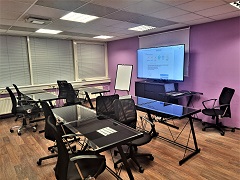
The course is conducted in a classroom format (up to 12 people in class) and/or online (Zoom / Microsoft Teams); total group size up to 18 people. The Python foundations block is held jointly with the group of the Fundamentals of the Python Programming Language course.
Training language: English
Price: 1700 EUR (VAT 24% included)
Total course volume: 120 ac/h (64 classroom + 56 independent)
Format: lectures + practical work + independent work.
Tutors
Roman Kutselepa (Python foundations block)
 Qualification: over 5 years of Python development and over 3 years of JavaScript development; participated in software-integration projects.
Specialisation: Python development, web development, software solution integration.
Teaching experience: over 5 years of teaching and staff-training experience.
Education: Anglia Ruskin University, higher education (2010).
Nikolay Zubrilov (LLM block)
Qualification: Python developer and Data Scientist; AI/LLM developer at Mentastic; owner of Dataocean Analytics OÜ.Specialisation: Python, AI/LLM development, data analysis and data science (Pandas, NumPy, Scikit-Learn), SQL (PostgreSQL / MySQL), REST API (FastAPI / Flask), automation.
Teaching experience: instructor on data analysis, Python and LLM testing courses at Gamma Intelligence Training Centre.
Education: Master's degree — computer and systems engineering.